
How to Quote a House Build (Step-by-Step)
QR Rise
Contributor, QRRise
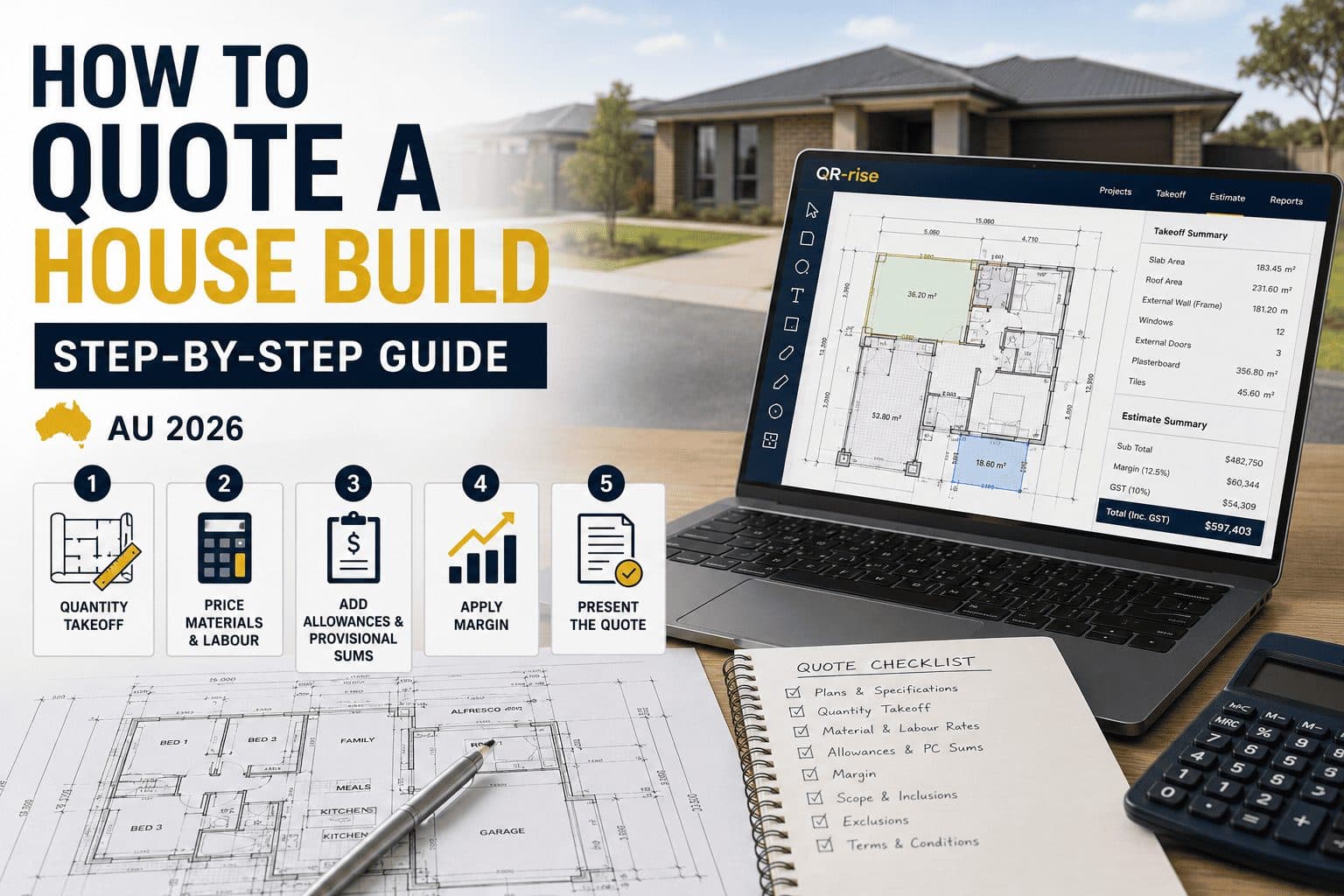
Learning how to quote a house build comes down to five steps: do a quantity takeoff from the plans, price materials and labour against current rates, add allowances and provisional and prime-cost sums, apply your margin, then present it as a clear scope-based quote. The accuracy of the quote lives or dies on the takeoff: under-measure the slab or the roof and the margin disappears. This guide walks each step, with an example, and shows where estimating software removes the manual maths.
We will follow one example throughout: a single-storey, four-bedroom brick-veneer home on a flat suburban block, quoted from working drawings.
Step 1: Do the Quantity Takeoff
The quantity takeoff converts the drawings into measurable quantities: slab area in square metres, wall frame in lineal or square metres, roof area, window and door counts, plasterboard, tiling, painting areas and so on. Work trade by trade in construction order so nothing is skipped, and record every quantity against the drawing revision you measured from.
On our example house, that means measuring the slab area, wall lengths, roof plan area adjusted for pitch, and counting openings, fixtures and power points. Doing this with a scale rule works, but it is slow and unforgiving: a missed wing on the slab is money gone before you have priced a single item. Construction takeoff software does the same job on screen: set the scale on the PDF once, then click out areas, lengths and counts, with AI-assisted detection handling repetitive symbols.
Step 2: Price Materials and Labour at Current Rates
Take each quantity and price it: materials from live supplier pricing (not last year's invoice), and labour either from subcontractor quotes or your own crew rates. Add realistic waste factors, because concrete, timber, plasterboard and tiles all lose a percentage between the delivery and the finished surface. Get written subbie prices for the big packages (slab, frame, roof, electrical, plumbing) rather than allowances wherever you can; every package you price from a real quote is risk removed from your number.
For the example house, that means a concreter's price against the measured slab, a frame quote against the frame quantities, roofing per square metre, and supplier pricing on windows from the count. Keep every rate you confirm; a reusable rate library makes your tenth quote faster than your first.
Step 3: Add Allowances, Provisional Sums and Prime-Cost Sums
No house build is fully priceable at quote stage. Cover the gaps honestly:
- Provisional sums for work you cannot fully price yet: excavation in unknown ground, rock, service connections.
- Prime-cost sums for items the client has not selected: tapware, appliances, tiles, light fittings.
- Preliminaries: site facilities, temporary fencing, scaffold, waste, supervision, insurances.
Label every allowance so the client understands which figures can move. A lowballed tile allowance wins the job today and burns the relationship at selection time. On our example, the ground is flat and known, so provisional sums are modest, but the client has not chosen a kitchen, so the PC sums there are meaningful and clearly flagged.
Step 4: Apply Your Margin
Work cost-plus: total your true cost (trades, materials, prelims, allowances), then add overhead recovery and profit as deliberate percentages. Builders' margins vary with region, job size and risk, so resist copying someone else's number. The discipline that matters is separating cost from margin: when a client negotiates, you need to know whether you are trimming fat or cutting into cost. Then add GST and show it as its own line.
Step 5: Present a Clear, Scope-Based Quote
The final document should carry a written scope of works by stage, itemised pricing, labelled provisional and PC sums, GST, exclusions, staged payment terms consistent with your state's rules, a validity period and an acceptance block. A well-structured document wins jobs against vaguer competitors, so use our construction quote template as the skeleton and nothing gets left out. Our example house lands as a branded PDF: scope by stage, itemised lines, PC sums flagged, 30-day validity, deposit plus five progress stages.
Where Building Quotes Go Wrong
Most building quotes come unstuck on the same handful of mistakes:
- Takeoff errors: the slab measured off an old revision, the roof priced at plan area with no pitch adjustment, an entire garage missed.
- Stale rates: pricing this year's job with last year's timber and steel numbers.
- Missing preliminaries, which quietly cost real money on every build.
- Unlabelled allowances that clients read as fixed prices.
- Totals that drift: a spreadsheet formula overwritten somewhere between version 3 and version 7, so the quoted total no longer matches the lines.
If you are quoting a knock-down rebuild rather than a vacant block, demolition, disconnections and site constraints add a layer of cost on top of everything above, so measure and price those items as their own stage.
How to Quote a House Build Without the Manual Maths
Every step above has a manual failure point, and estimating software exists to close them. In QR-rise, the takeoff happens on screen: set the plan scale once, measure areas, lengths and counts, and let AI-assisted detection speed up the repetitive items. Every measurement links to an estimate line, so when the architect issues revision C, you re-measure the changed pages and the price recomputes with no re-typing. Rates come from your reusable cost library, GST and provisional and prime-cost sums are built in, and pricing runs server-side so the quoted total can never drift from the lines behind it. The finished quote goes out as a branded PDF the client can approve, then converts to invoices with staged payments matching your contract stages.
Quote your next house build in QRRise — start free
Run your next house quote through QRRise and let the takeoff drive the price. Start free — no card. Upgrade to Pro when you need unlimited takeoffs and quotes.
Frequently asked questions
How long does it take to quote a house build?
Manually, a full takeoff and priced quote typically takes days of work spread across supplier and subbie turnaround. With on-screen takeoff and a maintained rate library, the measuring and pricing compresses dramatically; the waiting is then mostly on subcontractor quotes.
What margin do builders put on a house build?
There is no single figure: margins vary with region, build type, job size and risk. What matters is calculating your own overhead recovery and profit deliberately on top of true cost, rather than adopting a rumoured industry percentage.
What is the difference between a quote and a tender for a house build?
A quote is your offer to build the documented scope for a price; a tender is a formal response to an invitation, often against set conditions. For most private residential clients, you are quoting.
Should a house build quote include GST?
Yes. If you are registered for GST, show the subtotal, the GST amount and a GST-inclusive total so the client knows the bottom line is the amount they will pay.

