Free Construction Quote Template (Australia) — Excel, Word & PDF
Every job you win starts with a quote — and every hour you spend building one in a blank spreadsheet is an hour you’re not on the tools. This page gives you a free construction quote template built for Australian builders and trades: GST-ready, itemised by labour and materials, and available in Excel, Word and PDF. Grab it below, or read on for exactly what to put in each section so your quotes look professional and win work.
⬇ Download the free construction quote template → Excel, Word and PDF, no strings.
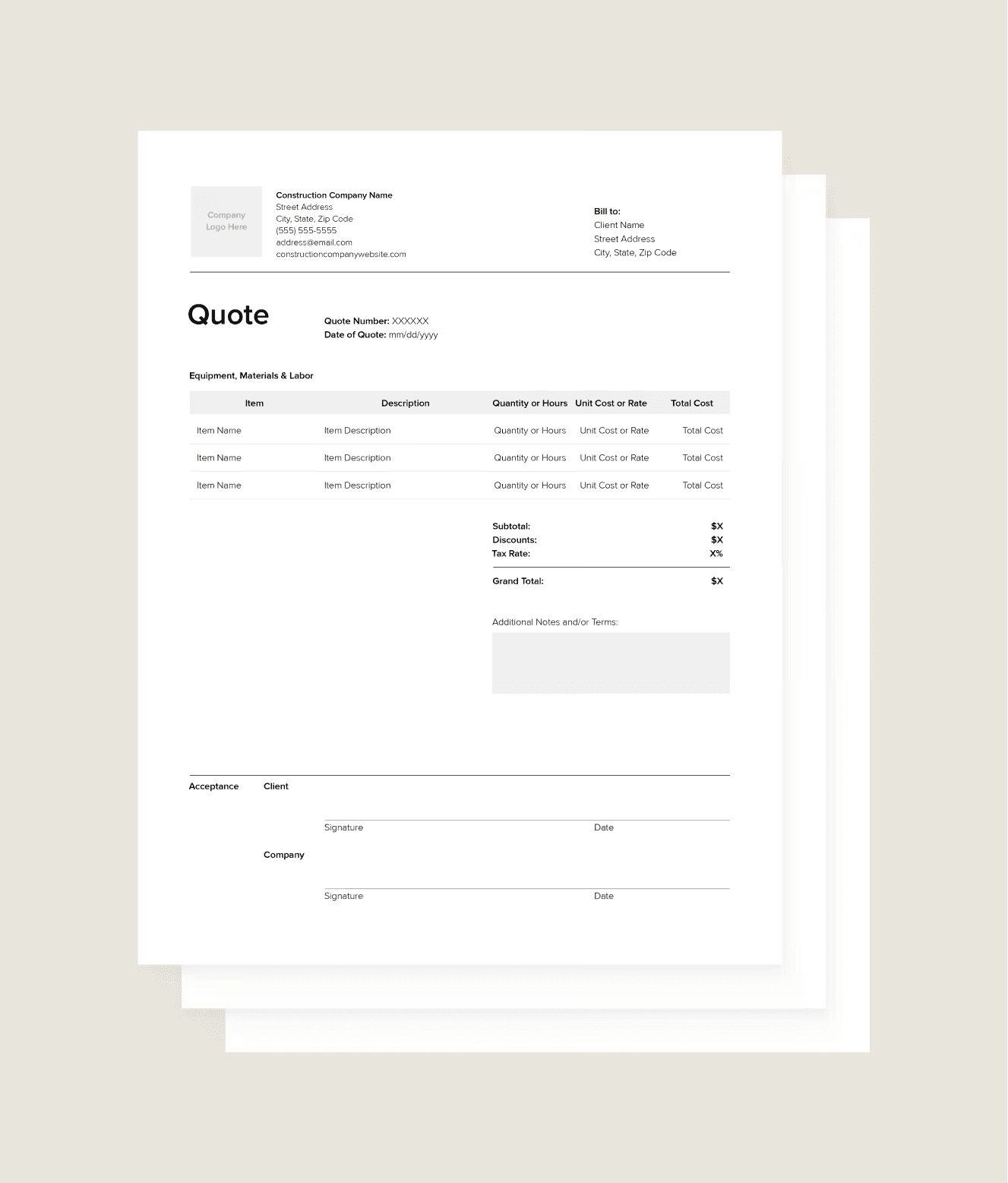
What’s inside the template
A good quote does two jobs: it wins the client’s trust, and it protects you if the scope changes later. This construction quoting template is laid out to do both. It includes:
- Your business header — business name, ABN, licence number, phone, email and logo space. (If you’re GST-registered, your ABN needs to be on there.)
- Client and job details — client name, site address, quote number and date.
- Scope of work — a plain-English description of what you’re quoting, so there’s no argument later about what was and wasn’t included.
- Itemised line items — grouped by trade or stage (e.g. site prep, framing, plumbing, electrical, finishes), with columns for description, quantity, unit, rate and line total.
- Labour vs materials split — so the client sees where the money goes, and so you can adjust one without redoing the whole quote.
- Subtotal, GST (10%), and total — calculated separately, the way an Australian quote should show them.
- Inclusions and exclusions — the section most tradies skip and later regret.
- Payment terms, deposit and quote validity — how and when you get paid, and how long the price holds.
- Acceptance block — a signature line so an accepted quote becomes a clear agreement.
The Excel version totals the line items and GST for you automatically. The Word and PDF versions are there for when you’d rather type it up or send a clean, locked document.
Pick the format that suits how you work:
- Excel (.xlsx) — best if you want the maths done for you. Enter your quantities and rates; subtotals, GST, and the total calculate themselves.
- Word (.docx) — best for a written, more descriptive quote where you’re not itemising heavily.
- PDF — best for sending a final, tidy document the client can’t accidentally edit.
(Free download. Australian format — prices ex-GST with GST shown separately.)
What a good building quote needs in Australia
A building quote template is only as good as what you put in it. A few things matter more here than elsewhere:
Show GST correctly. If you’re registered for GST, list your prices excluding GST, then add GST (10%) as its own line before the total. A quote that hides GST inside the numbers looks amateurish and causes disputes at invoice time.
Put your ABN and licence on it. Clients — and their finance people — expect to see your ABN. In most states, building and trade work above certain values requires a licence number on your paperwork; include it.
Itemise, don’t lump. A single “$48,000 — renovation” line invites price-shopping and haggling. Broken into stages and trades, the same number reads as considered and fair, and it makes variations easy to price later.
Spell out inclusions and exclusions. This is where money is lost. State what’s included (e.g. “all framing timber and labour”) and what isn’t (“excludes electrical fit-off, tiling and any rock excavation”). It’s your best protection against scope creep.
Set a validity period. Material prices move. “This quote is valid for 30 days” is standard and protects you when a client sits on it for two months, and timber’s gone up.
Add a variations clause. One line — “any changes to the scope above will be quoted separately before work proceeds” — saves you the awkward conversation later.
Want the full walkthrough? See How to quote a building job in Australia → for a step-by-step guide to pricing labour, materials and margin.
How to fill it out
- Start with the header — your details, the client’s, a quote number, and today’s date.
- Write the scope in plain English before you touch numbers. Get this right, and the line items almost write themselves.
- List materials by stage or trade, with quantity, unit, and rate.
- Add labour — hours × your charge-out rate, or a fixed price per stage. Don’t forget your own time on site.
- Check your margin. Your rates should already carry your markup — if they don’t, add it before the subtotal, not as an afterthought.
- Let GST and totals be calculated (Excel) or add them manually (Word).
- Fill inclusions, exclusions, terms and validity — the parts that protect you.
- Send it as a PDF so it can’t be edited.

Trade-specific quote templates
A general template works, but a template built for your trade — with the line items you actually use — is faster. We’re building versions for each:
- Carpentry quote template →
- Electrical, plumbing, painting, and landscaping templates — coming soon.
Each one uses the same GST-ready structure with trade-specific line items and units already filled in.
Quoting mistakes that cost you jobs — and money
- Under-quoting to win the job. You win the job and lose money on it. Price properly; compete on trust and clarity, not just the lowest number.
- Vague scope. “Bathroom reno — $22k” with no detail is a dispute waiting to happen. Itemise.
- Forgetting GST or margin. Both are easy to leave out of a spreadsheet you’re rushing. Both come straight out of your pocket.
- No variations clause. Without it, every client change becomes a favour you did for free.
- Slow quotes. The builder who quotes in two days beats the one who takes two weeks, even at a higher price. Speed wins work.
When to move on from a template
A spreadsheet template is perfect when you’re sending a handful of quotes a month. But if you’re quoting most weeks, the cracks show: re-typing the same line items, doing quantity take-offs by hand off the plans, chasing your own maths, and hoping your pricing stayed consistent across three quotes you did last Tuesday.
That’s the point where a purpose-built tool pays for itself. QR-rise is estimating and quoting software built for Australian builders and trades: do your take-offs straight from the plans, let it calculate quantities and totals automatically, keep your rates consistent across every quote, and send a branded, GST-correct PDF in minutes instead of an afternoon.
The template gets you a professional quote today. QR-rise gets you your evenings back.
See how QR-rise pricing works → — plans built for solo tradies through to SME builders.
Construction quote template FAQ
Is the construction quote template really free? Yes — download the Excel, Word and PDF versions above at no cost, and use them on as many jobs as you like.
Does the template include GST? Yes. It shows prices excluding GST, adds GST (10%) as a separate line, then the total — the correct format for an Australian quote. The Excel version calculates it automatically.
Can I use it in Excel or Google Sheets? The Excel (.xlsx) file opens in Excel and imports into Google Sheets. The formulas for subtotals and GST carry across.
What’s the difference between a quote and an estimate? An estimate is your best approximation and can change. A quote is a fixed price you’re committing to (subject to your inclusions, exclusions and validity period). Australian clients generally expect a quote for defined work — so be clear which one you’re sending.
How long should a quote be valid? Thirty days is standard for construction work. It protects you if material prices move before the client accepts. State the validity period clearly on the quote.
Is there a building quote template for Australia specifically? This is it — built to Australian format with GST, ABN and licence fields, and Australian trade categories. Use it as-is or adapt the line items to your trade.
Ready to send your next quote? Download the free template → — or start quoting faster with QR-rise →.