
What Is a Cost Plus Building Contract?
qrrise
Contributor, QRRise
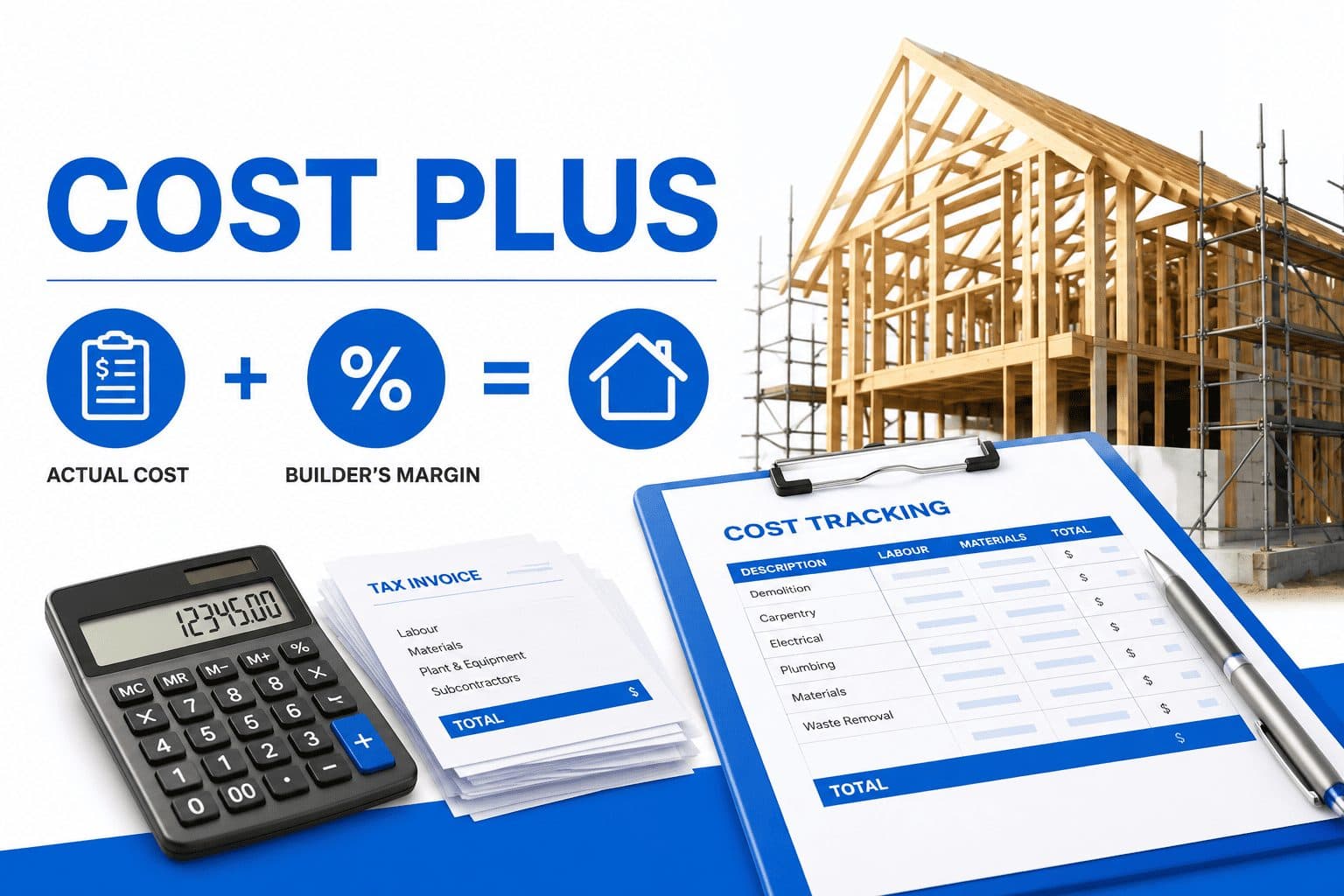
A cost plus building contract is an agreement where the client pays the actual cost of labour and materials plus an agreed margin (a percentage or fixed fee), rather than a single fixed price. It suits jobs where the scope isn't fully defined up front, like renovations and custom builds. This guide explains how cost-plus works, its advantages and risks for both parties, and how transparent cost tracking keeps it fair, which is exactly how QR-rise prices estimates.
How a Cost Plus Building Contract Works
Under a cost plus contract in construction, the builder records the actual costs of delivering the job (labour hours, materials, subcontractor invoices, plant hire, and often a defined share of site overheads) and bills the client those costs plus the agreed margin, usually on a regular claim cycle. The contract defines which costs are claimable, what records must support each claim, and how the margin is applied.
Because the client pays actual cost, the contract usually includes an upfront estimate of the likely total, a duty to keep records the client can inspect, and sometimes a cap or target. Standard-form cost-plus contracts from the major Australian industry bodies (the HIA and Master Builders families) set out these mechanics; details differ between forms and states, so read the specific contract you're using.
Percentage Margin vs Fixed Fee
The "plus" can be structured two main ways:
- Percentage margin. The builder adds an agreed percentage to every dollar of claimable cost. Simple to administer, and the margin scales with the work, but the builder's fee grows if costs grow, which is the arrangement clients most often worry about.
- Fixed fee. The builder's margin is a set dollar amount regardless of final cost. This removes the incentive concern, since the builder gains nothing from cost growth, but the builder carries the risk of the job running much longer than the fee assumed, so scope needs to be reasonably bounded.
Hybrids exist too, such as a percentage margin capped by a guaranteed maximum price.
Cost Plus vs Fixed Price
Wondering about cost plus vs fixed price? The core trade-off is who carries the pricing risk:
- Price certainty. Fixed price gives the client a known number up front; cost-plus gives an estimate that can move with actual costs.
- Risk allocation. Under fixed price, the builder wears cost overruns (and keeps savings); under cost-plus, the client wears overruns (and keeps savings).
- Contingency. Fixed prices include a risk allowance for unknowns; the client pays for that buffer whether or not the risk eventuates. Cost-plus strips the buffer out and charges only what actually happens.
- Scope definition. Fixed price needs complete drawings and specifications to price fairly; cost-plus can start with partial scope, which is why it suits renovations.
- Administration. Fixed price is simpler to claim and check; cost-plus demands detailed cost records, open books and more client engagement.
- Speed to start. Cost-plus can begin before design is finished; fixed price generally can't be sensibly agreed until it is.
Neither model is universally better; the right choice depends on how well the scope is defined and how much price certainty the client needs.
Pros and Cons for Builder and Client
For the builder, cost-plus removes the biggest fear in fixed-price work: absorbing overruns from an underquote or an unknown site condition. Margin is protected and the job can start sooner. The downsides are administrative (every dollar must be documented and defensible) and reputational: if costs blow past the estimate, the relationship sours even when the builder did nothing wrong.
For the client, cost-plus means paying only what the job actually costs, with no hidden contingency and full visibility of the books. The risks are the mirror image: no firm ceiling on the total, dependence on the builder's record-keeping, and a lender problem, as many banks are cautious about financing cost-plus builds because the end figure is open.
Risk Controls That Keep Cost-Plus Fair
A cost-plus job works when both sides trust the numbers. The practical controls:
- A genuine, itemised estimate up front. Even though the price isn't fixed, a well-built estimate, ideally started from a proper construction quote template, sets shared expectations and becomes the benchmark actual costs are tracked against.
- Clear definition of claimable costs: what's in (labour rates, materials at invoice, subbies) and what's out (rework from builder error, for example).
- Regular, transparent claims with supporting records the client can actually follow, not a monthly lump sum.
- Caps or targets where appropriate, such as a guaranteed maximum price.
- Provisional sums and prime-cost sums for undecided items, adjusted to actuals as selections are made.
- Written variations for scope changes, even under cost-plus; scope creep without a record is where disputes start.
One important caution: the rules for residential cost-plus contracts vary by state, and some states restrict or condition the use of cost-plus for home building work. Before signing, check the contract form and your state building authority's requirements, and get advice if you're unsure.
Why Transparent Estimating Matters (and Where QR-rise Fits)
Cost-plus lives or dies on transparency, and transparency starts with the estimate. If your upfront estimate is a handful of round numbers, every claim afterwards is an argument. If it's an itemised build-up (measured quantities, rates, subcontract packages, provisional sums, GST), every claim is a comparison against an agreed baseline.
That's exactly how QR-rise works. You do the takeoff on screen from the PDF plans, each measurement links to an estimate line, and pricing is calculated server-side under a cost-plus model (costs plus your margin) with GST and provisional and prime-cost sums handled properly. The result is a branded, itemised quote the client can interrogate line by line, which then flows through to invoices as the job progresses.
If you run cost-plus jobs, or want the option to, purpose-built construction estimating software australia beats spreadsheets for keeping the baseline defensible; home builders can see our guide to residential construction estimating software. QR-rise keeps every cost-plus claim tied to an itemised baseline, so your open-book records hold up when the client inspects them. Start free — no card, and build one real estimate to see how much cleaner your next cost-plus claim is.
Frequently asked questions
What is a cost plus contract in construction?
It's a contract where the client pays the builder's actual, documented costs of labour, materials and subcontractors, plus an agreed margin, either a percentage of cost or a fixed fee, instead of a single fixed price agreed up front.
Is cost plus cheaper than fixed price?
Sometimes. The client avoids paying the contingency built into a fixed price, so if the job runs smoothly, cost-plus can come out cheaper. But if costs overrun, the client wears it; there's no ceiling unless the contract adds one.
What margin is typical on a cost plus contract?
Margins vary with the job's size, complexity and risk, and with what the margin has to cover. There's no single standard figure; the margin is whatever the parties agree, so make sure the contract defines it precisely.
Are cost plus contracts legal for home building in Australia?
Rules vary by state. Some states restrict or place conditions on cost-plus contracts for residential building work. Use a recognised standard contract form and check your state building authority's requirements before signing.

